21.03° N, 105.85° E · International
Vietnam
Limestone bays, lantern-lit old towns and a golden bridge in the clouds.
Why go
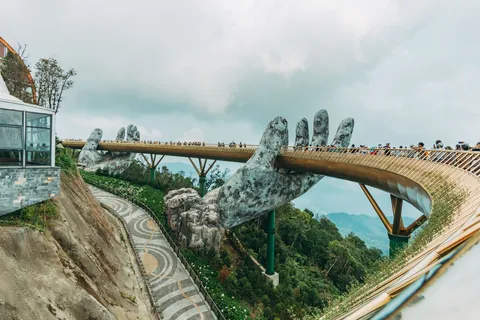
Vietnam is a good next step for families who have already seen Thailand or Singapore. It has sights the others do not: a bay of limestone islands seen from a cruise boat, an old trading town lit by silk lanterns, and a golden bridge held up by giant stone hands on a misty hill. The old quarter of the capital is busy with scooters and street kitchens, and the whole country runs on strong coffee.
It suits couples and families with teenagers best. Distances are long, and the best moments involve walking through old lanes and markets. Seniors manage well on a slower plan with an overnight bay cruise, the beach city and the hill park by cable car. Children enjoy the boat days and the water-puppet show.
Food needs more planning here than in most places. Vietnamese cooking uses a lot of fish sauce. Look for Buddhist vegetarian eateries, called "com chay", and the Indian restaurants found in every city on the usual route. Our groups take Indian meals there.
When to go
- JJanuary
- FFebruary (good)
- MMarch (good)
- AApril (good)
- MMay (good)
- JJune (good)
- JJuly
- AAugust
- SSeptember
- OOctober (good)
- NNovember (good)
- DDecember (good)
- October to DecemberThe north is cool and clear, while the central coast has its rainy season with some storms. The south is drying out. A good time for the north.
- January to MarchThe north is cold and grey, 12 to 18 °C with drizzle, and the bay can be misty. The south is dry and warm. The lunar new year closes many shops for about a week.
- April to JuneThe best all-round months: warm everywhere, calm seas in the bay and the central beaches at their best. A good choice for families.
- July to SeptemberHot and humid with afternoon rain in the north and south. The central coast is dry and sunny, and the lantern town looks its best in the evenings.
Getting there
- By airFlights from the nearest big airport with one change; we book the best connection for your dates. Inside Vietnam, short flights link the north, centre and south. Vietnam is 1 hour 30 minutes ahead of India.
- By trainNot needed to get there. A long-distance train runs the length of the country, with a scenic stretch over a coastal pass in the centre.
- By roadNot needed to get there. The bay is a few hours by road from the capital, and the lantern town is a short drive from the beach city.
- PickupPickup from Satara and Phaltan can be arranged for group departures.
What you will experience
- 01Overnight cruise among limestone islandsKayaking, caves and sunrise exercise on deck in a calm, green bay.
- 02Walk through the old quarterNarrow trade streets, a lake in the city centre and a water-puppet theatre.
- 03The golden bridge in the hillsA bridge held by giant stone hands, reached by a very long cable car.
- 04Lantern-lit old trading townYellow houses, a covered bridge, lantern boats and tailors who stitch overnight.
- 05Beach city and marble hillsA long sandy beach and limestone hills with caves and pagodas, with a lift up.
- 06A boat day in the river deltaSmall boats through coconut canals, fruit orchards and village workshops.
Tour Vietnam with us
Practical
- Vegetarian food
- Indian restaurants are found in every city on the usual route, and group tours take lunch and dinner at them. For local food, look for "com chay" (Buddhist vegetarian) eateries, which serve rice, tofu, mushrooms and vegetables without fish sauce. In ordinary restaurants say "an chay" (I eat vegetarian) and check for fish sauce. Jain food is difficult outside Indian restaurants, so please tell us early.
- Documents and permits
- Indian passport holders need a Vietnam e-visa, applied for online on the official government portal about two weeks before travel. It usually takes a few working days. Carry the printed approval, a passport valid for at least six months, hotel bookings and a return ticket. Visa on arrival without prior approval is not available. Rules change, so we confirm for your dates and can apply for you.
- Phones and money
- The local currency is the Vietnamese dong, and its notes carry many zeros, so learn the colours of the notes on the first day. Cash is the norm in markets, taxis and small restaurants, while cards work in hotels, malls and larger restaurants. UPI is not accepted. Tourist SIM cards are sold at the airport, e-SIMs work well and ride apps are reliable.
- What to carry
- Passport with six months' validity and the printed e-visa approval
- A light jacket for the north between November and March
- Walking shoes for old towns, caves and marble hills
- Sunscreen, a hat and swimwear for the beach and the cruise
- A currency app to keep the many zeros on the notes straight
Questions about Vietnam
Is Vietnam harder than Thailand for a vegetarian family?
A little, but it is manageable. Indian restaurants exist in every city on the route, and Buddhist "com chay" eateries serve fully vegetarian local food. Our groups eat at Indian restaurants, so the planning is done for you.
How does the e-visa work?
You apply online on the official portal with a passport scan, a photograph and your travel dates, and receive an approval by email to print and carry. It usually takes a few working days. We can file it for you. Apply at least two weeks before travel.
How many nights do we need?
Most families take six to eight nights to see the north, centre and south. Five nights works for the north and centre alone, which many families prefer.
Is the overnight bay cruise suitable for seniors?
Yes. The boats are steady inside the bay, cabins have attached bathrooms and air conditioning, and vegetarian meals are served on board with notice. Kayaking and cave walks are optional. A day cruise is also possible.